
TrackTribe: Building a Music Discovery App That Spotify Won’t Let Me Launch
I had the idea while building a dating app months earlier. I was thinking about how much I love music, and how all dating apps follow the same format (swipe right for a like, left if not). Why not build one that matched you by music taste instead? But then I realised limiting it to dating felt like a waste. The idea was bigger than that.
What struck me was that Spotify, despite its brilliant recommendation algorithm, had no real community.
The algorithm works wonderfully. It knows what you’ll like based on your history, your playlists, your taste. But it’s missing something fundamental. You see people (influencers!) on Instagram and TikTok sharing their ‘top five albums’ to listen to, their ‘best releases of the week’, their ‘if you like Bossa Nova, you have to listen to this’l lists. I felt that Spotify should move into that space too – or facilitate a way for users to be more vocal about their music recommendations. It should be a place where users share their music, discover new playlists and artists, and connect with the people who created them.
So I built a dating app anyway. That became Fourank. But the music discovery idea stayed with me. By late January 2026, I decided to actually build it.
The app is called TrackTribe (t was originally called SpottyPpl but Spotify forbids anything starting with “Spot”), and the concept is a social discovery platform where you match with people based on music taste, not appearance.
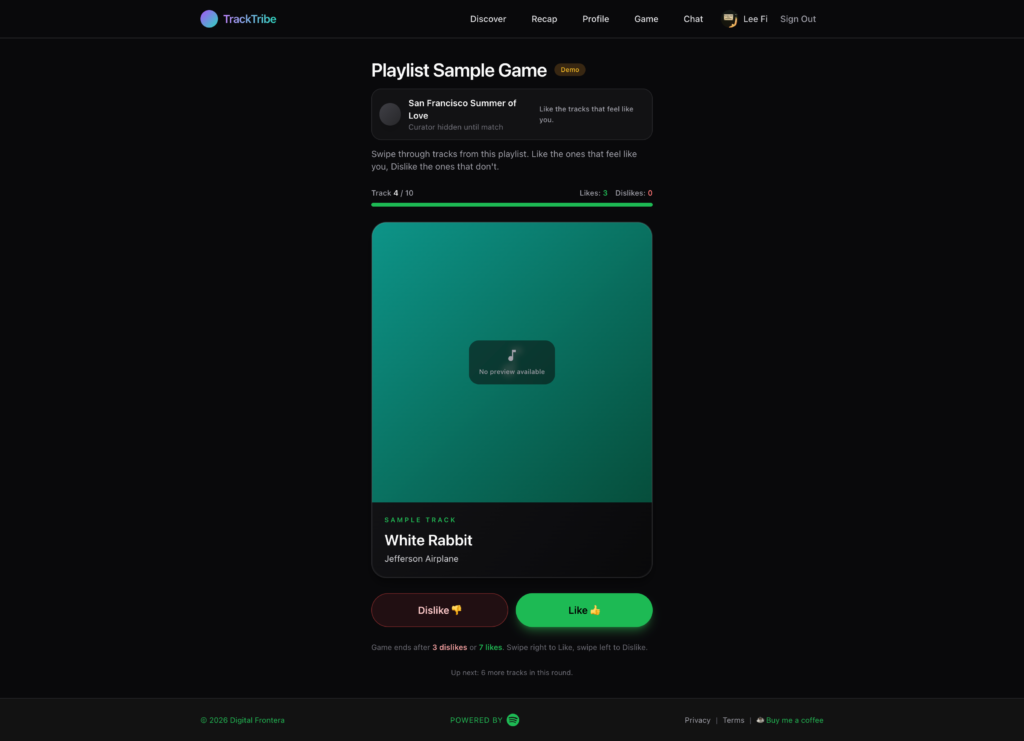
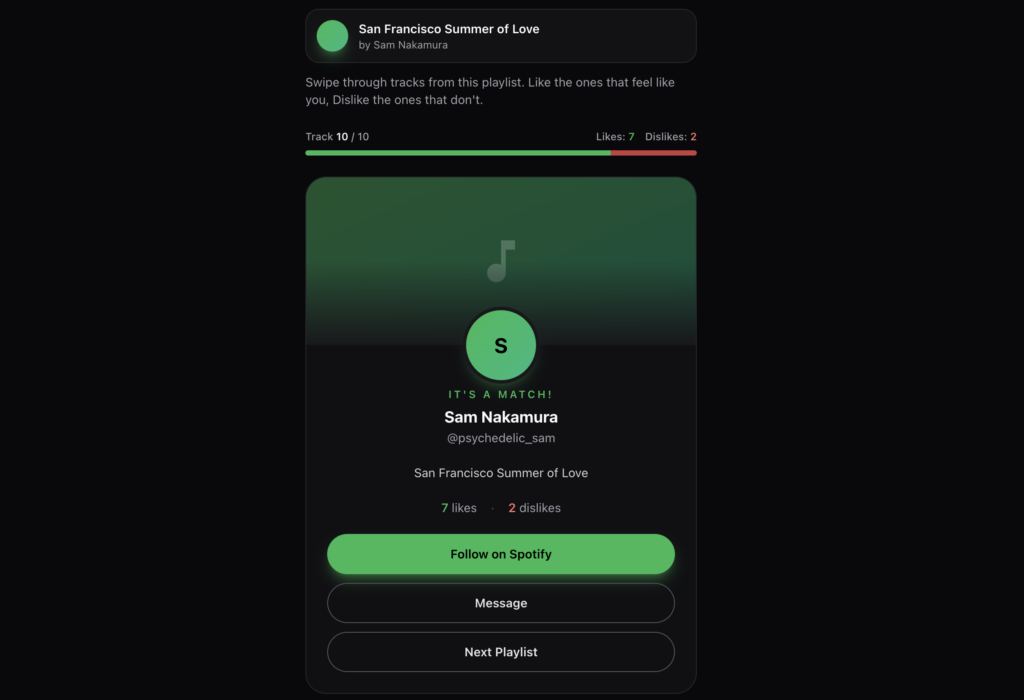
The core mechanic is a game where you listen to 30-second song previews from someone’s playlist and swipe through them. Swipe RIGHT on seven songs and it’s a match. This then reveals the full playlist, the user who curated it, and you have the option to then follow the user, follow the playlist, and drop the user a message. If you swiped LEFT on three of the sample songs, it’s not a match, and you move on to the next playlist in the game.
The build took a couple of months. The app is partially built. And only works to a certain extent, for up to five users only. because Spotify won’t let it.
The Concept
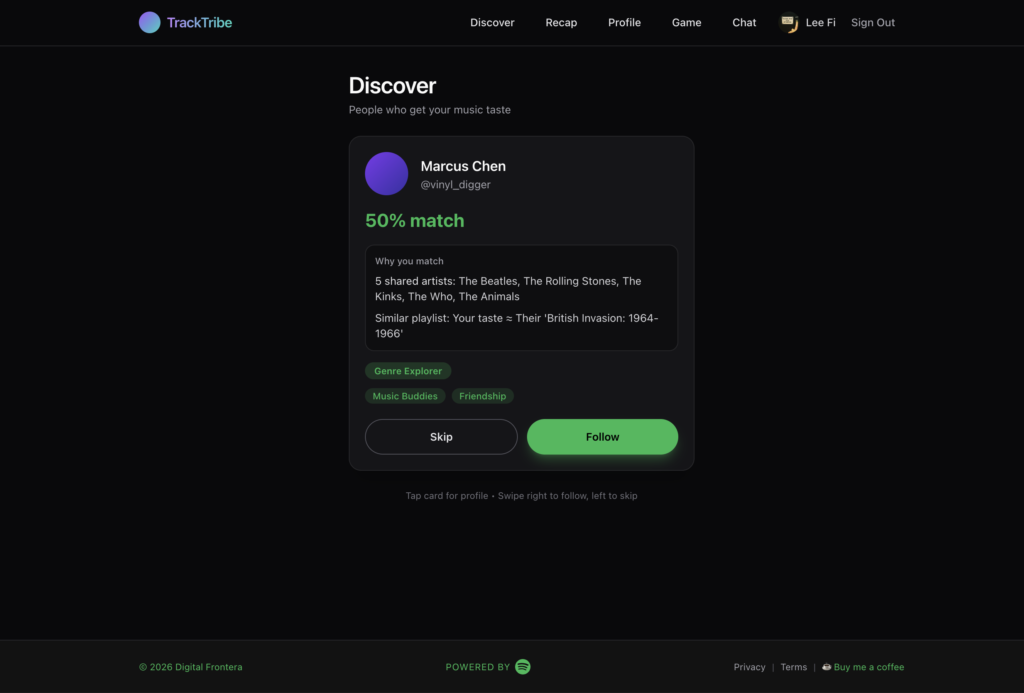
The problem felt real. Dating apps like Tinder have bolted Spotify onto profiles—you can show your top artists—but it’s decorative. It doesn’t drive the matching. It’s an afterthought. Meanwhile, Spotify itself added messaging between users, but there’s no social discovery layer. No platform uses music taste as the primary way humans connect.
I wanted to fill that gap (and still do).
The core feature was the Playlist Game. A user gets shown a mystery playlist from a stranger. They listen to ten songs at thirty-second previews. They swipe: like this song, or dislike it. Three dislikes and the game ends. Seven or more likes and it’s a match—the playlist creator’s identity is revealed, and you can follow or message them.
The innovation wasn’t complicated. It was simple: taste comes first. You don’t see a photo or a bio. You only hear music. And if you genuinely like seventy percent of someone’s taste, meeting them feels earned, not arbitrary.
The Build: Three Months, Two Tools
I started in January. The plan was to use Cursor, an AI-powered code editor, with Claude providing architecture decisions. I’d describe what I wanted, Cursor would generate the code, I’d review it and iterate. This approach, sometimes called vibe coding, seemed faster than writing every line manually.
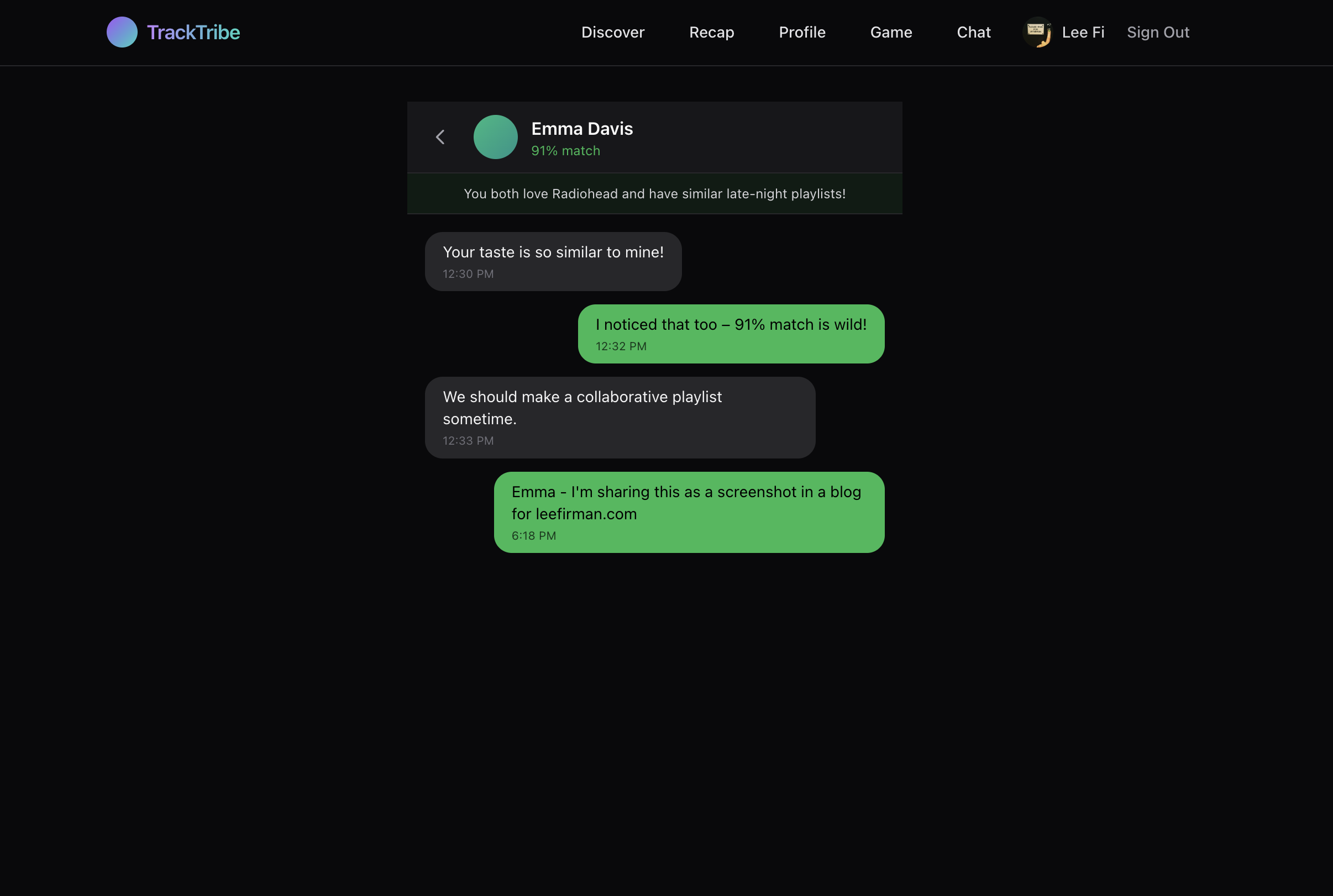
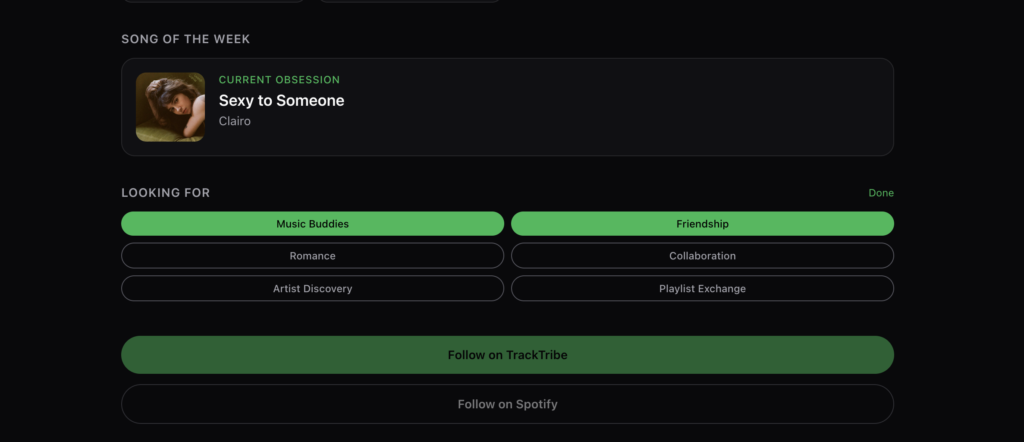
I built five full pages: Home (landing page), Discover (match cards), Profile (music stats), Game (the core mechanic), and Chat (messaging interface). I deployed everything to Vercel. By the end of January, I had a working UI with mock data. It looked real. It felt responsive. You could actually play the game with fake playlists.
Then I hit a problem. I was using Perplexity as a second AI tool to help with features and code. Perplexity kept breaking things. It added “use client” directives to utility files where they didn’t belong. It didn’t understand Next.js conventions. It caused 404 errors and hydration mismatches. After a few days of debugging Perplexity’s mistakes, I realised this wasn’t helping. I switched to Claude Code.
Claude Code was different. It was faster to iterate with, better at understanding context, and didn’t introduce random bugs. The entire development flow improved. From that point on, I only used Claude and Cursor. No more Perplexity.
By early February, I had connected Firebase for authentication and started working on real Spotify integration. That’s when I ran into the actual walls.
The Spotify Problem
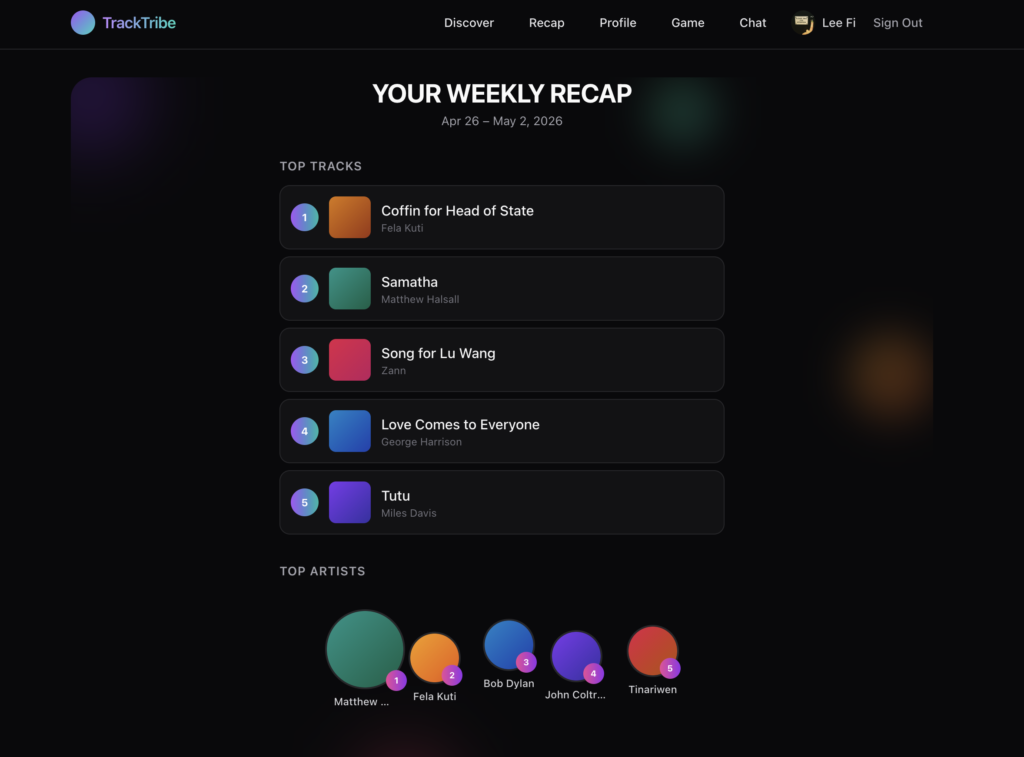
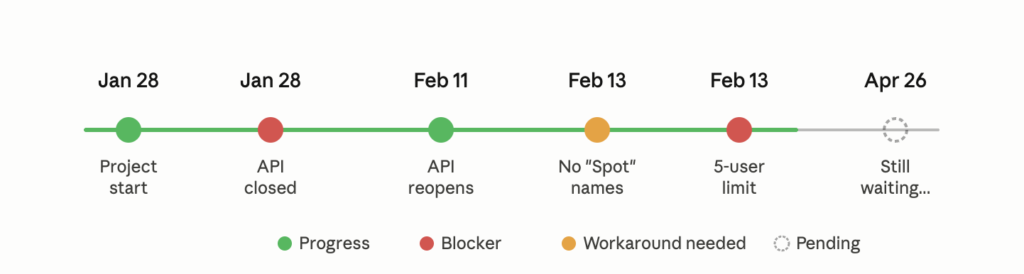
When I started the project in January, Spotify had suspended API access for new integrations. I couldn’t register a new app. I had to wait. So I built the entire thing with mock data—fake playlists, fake users, fake matches. Everything looked real. Everything worked. But nothing connected to Spotify.
In February, Spotify reopened API registration. I immediately applied. That’s when I discovered the naming restriction: anything associated with Spotify’s APIs cannot contain the word “Spot.” SpottyPpl was rejected. I rebranded to TrackTribe, registered that name, and got my API credentials.
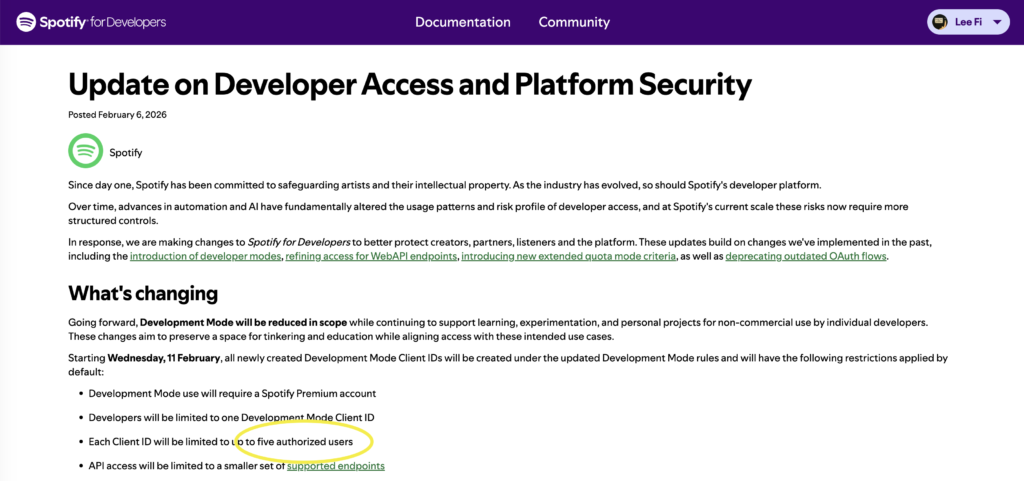
That’s also when I discovered the real problem: Spotify’s Development Mode limits apps to five authorised users.
Five users. That’s me plus four others. You can’t build a social app with five users. You can’t validate the matching algorithm with five users. You can’t test messaging, discovery, or any of the features that make the app function.
To launch publicly—or even to do meaningful testing—I need Extended Quota Mode approval from Spotify. That requires demonstrating a working product with a legitimate use case. But building that working product requires API access. It’s a chicken-and-egg problem.
I sent Spotify a detailed request. Weeks went by. No response. The request is still pending.
This wasn’t a problem in the past. Plenty of platforms exist using Spotify’s API. But Spotify decided sometime late in 2025 to restrict new ones. They’re protecting their ecosystem, which I understand. But it means I can’t launch unless they say yes.
What Actually Works
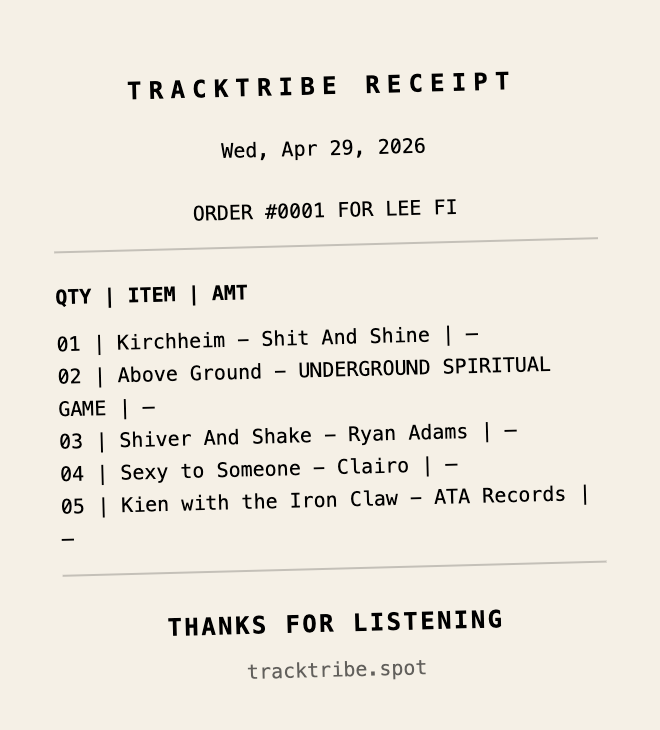
The UI is complete. The five pages load. You can sign in with Spotify, but first you have to be manually added to the approved user list. That’s part of Spotify’s constraint. The profile pages show mock data. The game interface exists—you can swipe through playlists, see the match percentage, everything renders correctly.
But here’s what doesn’t work: the game doesn’t connect to real Spotify playlists or play music. The matching algorithm isn’t active because there’s no real user data. The messaging doesn’t send messages to real users. The social discovery—the entire reason I built this—doesn’t function.
It’s like having the building but no electricity. The structure is there. The doors open. But nothing actually happens inside.
Why It Matters
Building TrackTribe taught me something I should have learned from AquiMaps: third-party platforms control whether your product can exist.
With AquiMaps, the problem was data quality. Mapillary’s user-generated imagery wasn’t good enough. The core idea was sound, but the underlying data source broke it.
With TrackTribe, the problem is more fundamental. I don’t have data quality issues. I have access issues. Spotify has decided that they want to control which apps get their data. I understand their reasoning. But it means I can’t launch unless they approve it.
This is different from building a SaaS product or a native app. You’re not in control. You’re at the mercy of another company’s API policies, rate limits, terms of service changes, and approval timelines. I anticipated this risk. I built it anyway, hoping Spotify would be cooperative.
They weren’t.
What I Learned
API dependency is real. Before you build on top of another platform’s API, research their policies exhaustively. Don’t assume they’ll grant you access or that their terms won’t change. Have a plan B, even if you think you won’t need it.
Vibe coding actually works. Using Claude Code and Cursor to rapidly prototype is faster and less frustrating than writing boilerplate manually. I built a five-page social app with game mechanics in days. That’s fast. But vibe coding only gets you so far. At some point, you hit real architectural problems that require human thinking, not AI generation.
Mock data first is the right approach. Building the entire UI with fake data meant I could validate the user experience before worrying about API integration. When Spotify finally opened access, I already knew what the product should feel like.
Platform dependency is existential risk. If Spotify changes their API, revokes access, or launches a competing feature, TrackTribe dies. There’s no business here without Spotify’s permission. This is why some founders multi-platform from the start—support Apple Music, Tidal, YouTube Music simultaneously so you’re not betting everything on one company’s goodwill.
The Door Stays Open
The idea itself is solid. I love it. I would use a service like this if it existed. I still think matching people based on music taste is more authentic than matching based on photos or demographics. The Playlist Game is fun to use. People who tested it locally wanted to keep playing.
If Spotify approves Extended Quota Mode, I know exactly what needs to be done next. The path is clear: build the real Spotify integration, connect real user data, test the matching algorithm, iterate on the core gameplay, then launch a beta.
If they don’t approve—if months pass with no response—I’d have to decide: do I support Apple Music and Tidal instead? Do I accept that this idea requires multiple platforms? Or do I move on to something I can actually control?
For now, TrackTribe sits in limbo. Built but not launched. Functional but not live. Waiting for Spotify to decide whether I’m allowed to ship it.
Check it out here, if you wish: www.tracktribe.spot
On Spotify
Let’s look a little closer at Spotify too, shall we?
I’ve been a Spotify user for over fifteen years. I loved watching a European company take on the giants of Google and Apple and actually win. I loved the way Spotify grew despite Apple Music throwing everything at it. They created something great. It’s cool, right?
But these days, Spotify is just another corporation. They don’t pay artists fairly, especially new artists. They’re pushing AI-generated music, which I think is wrong. The company I loved has become something I’m less enthusiastic about supporting.
Working with Spotify felt complicated anyway, ethically. An alternative like Tidal probably makes more sense going forward.
That’s the story of building a product on someone else’s platform. You can do everything right. You can execute flawlessly. You can build something people want. And then a company can say no, and you’re stuck.
Tidal, call me 😉
To be continued.
In the meantime, here’s the link to TrackTribe.spot.